
Signals Before Outcomes
Case Study Application
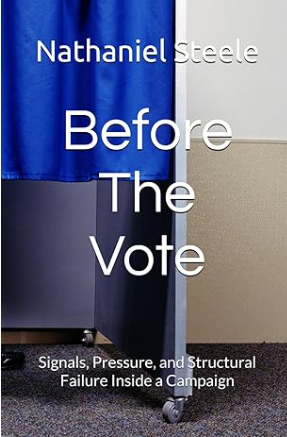
TruthLens is a governance-grade institutional operating system designed to study how institutions behave under pressure. Before The Vote is a live case study that shows how that system works within a campaign before the outcome is known.
This is not a campaign memoir. It is not a prediction product. It is not campaign consulting. The campaign is the case. The system is the point.
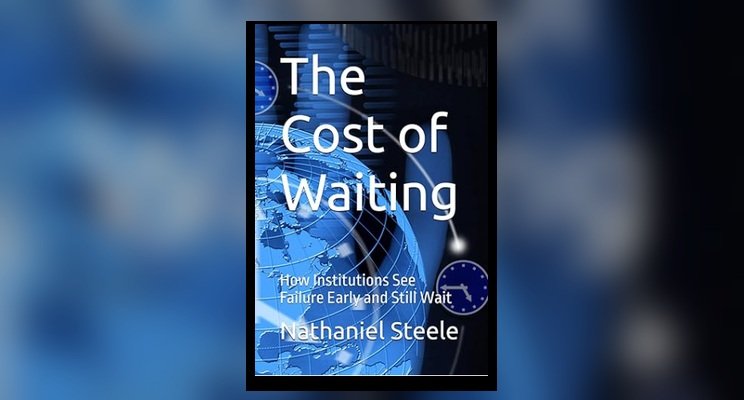
Institutions rarely fail all at once; they usually fail while the signals are still visible. The Cost of Waiting examines why organizations, leaders, and systems delay action until correction becomes more expensive, public, and difficult to reverse.
Through the TruthLens framework, the book shows how drift, coherence loss, and elasticity decay appear across business, governance, sports, politics, and public trust before collapse becomes obvious. Written for executives, analysts, civic observers, leaders, and serious readers, the book asks what changes when people can see failure early enough to act. Its argument is simple: the deepest cost is not collapse itself, but the time lost while visible signs were discounted and allowed to narrow the future.
What TruthLens is
A structural operating system for institutions under pressure
TruthLens studies the distance between what institutions say, what they do, and what becomes visible when those two things stop aligning. It is built for institutions that need to see structural pressure before failure becomes obvious.
It examines behavior while incentives are still shifting, narratives are still moving, and correction is still possible.
What this book is
A controlled case study of structural analysis before outcomes are known
Before The Vote documents a campaign as it unfolds. It preserves the pressure of uncertainty and examines what becomes visible before outcome knowledge can distort interpretation.
The book shows how structural signals emerge in real time—how decisions narrow, constraints accumulate, and narrative pressure reshapes available options inside a live institutional environment.
Tracks how movement and messaging shift under pressure
Reveals how option space narrows before it becomes visible publicly
Examines how narrative, incentives, and time compression interact
Demonstrates how outcomes are often visible in structure before they appear in results
Where it sits
Upstream of threshold-based control systems
Upstream of risk - TruthLens examines structural conditions before damage becomes measurable.
Upstream of the audit, it’s not retrospective testing; it’s testing ahead of time. It is an earlier signal detection.
Upstream of compliance - It looks at misalignment before formal violation or visible breakdown, and confirms the problem.
What This Work Is Not
Category control matters
Core primitives
Three structural concepts organize the analysis
Drift
Drift measures the distance that develops between what an institution says and what it does. It accumulates quietly through routine pressure, changed incentives, compressed time, and repeated exceptions.
Coherence
Coherence asks whether an institution’s words, policies, and actions still align across channels, actors, and pressure moments. It shows whether the system still speaks as one.
Why the campaign matters
The campaign is not the subject. It is the test environment
Elections compress time. Compression makes structural weakness easier to see. Momentum, donor pressure, coalition demands, media framing, identity stress, and public interpretation begin moving at different speeds.
What looks sudden near the end is often cumulative. What appears late is often old. The book makes those earlier signals visible while decisions are still open.
Before
Signals are studied before outcome knowledge reshapes interpretation
Early
Signals are studied before outcome knowledge reshapes interpretation
Elasticity
Elasticity measures whether a system can correct and regain trust without appearing unstable. When elasticity thins, even reasonable adjustments can trigger backlash.
Why the system matters
The same logic travels across institutions
The same framework can be applied to campaigns, hospitals, boards, school systems, sports organizations, corporate environments, and other institutions under pressure. The domain changes. The structural primitives do not.
That portability is the point. The book is one proof surface, not the limit of the method.
Portable
Signals are studied before outcome knowledge reshapes interpretation
Why a reasonable person should care now
Most institutions detect failure too late
Institutions rarely fail suddenly. They narrow, drift, harden, and misread pressure before collapse becomes obvious. TruthLens exists to make that earlier phase visible.TruthLens Analysis
What is happening
In politics and beyond, public narratives often outrun institutional reality. Confidence rises while option space shrinks. Volume increases while alignment weakens.

Why it is happening
Modern institutions operate inside pressure systems that reward speed, certainty, and emotional clarity more than disciplined correction. That structure hides early failure signals..
Read the case
Start with the book
Buy Before The Vote to see the case study in full. It documents what the archive made visible before the outcome was known and shows how structural interpretation can remain disciplined under uncertainty.
Explore the framework
review the operating system
Buy Before The Vote to see the case study in full. It documents what the archive made visible before the outcome was known and shows how structural interpretation can remain disciplined under uncertainty.
Author role
The author explains the work. The system carries the weight
TruthLens Analysis examines how institutions behave under pressure by studying drift, coherence, and elasticity across public narratives, decision systems, and observable conduct.